11 de septiembre
2002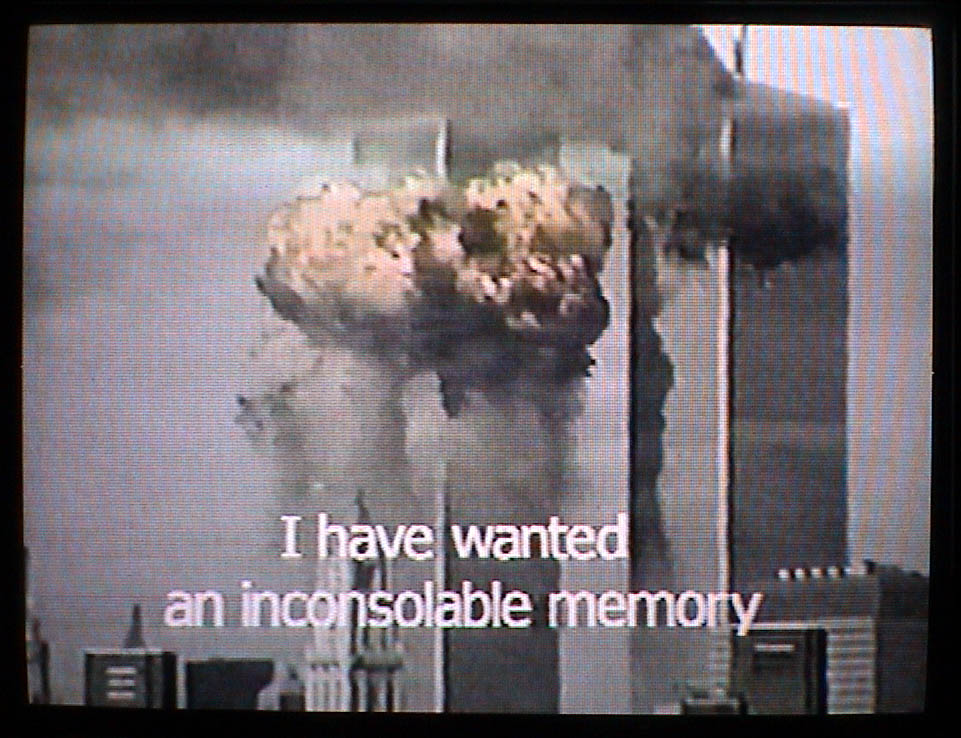


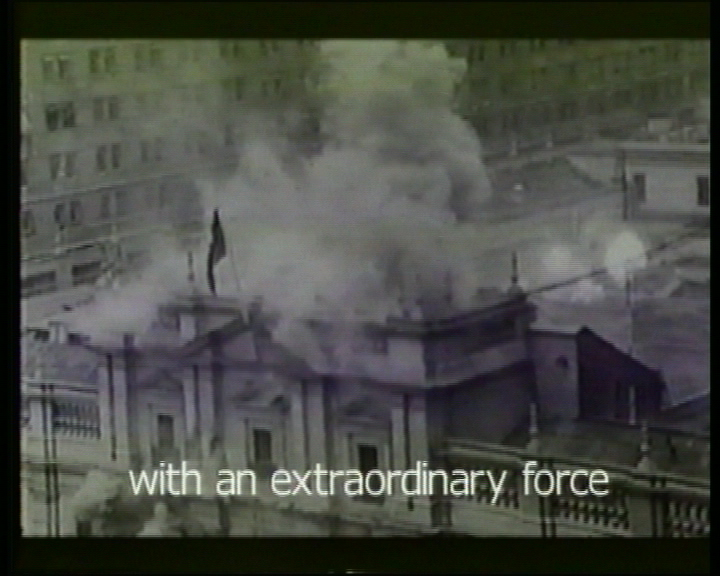
“11 de septiembre was a spontaneous production, violently determined by the date in question. Sort of an exaggerated reaction to the image and the date. As a matter of fact, my first reaction upon seeing the images of Manhattan on the TV (2001) was to associate this event of political violence as a response to the military coup in Chile. After a while, once the shock had subsided, I thought the groups that offered armed resistance during the dictatorship in Chile, which were still semi-active out there, didn’t possess the capacity to do something like that, that it was out of their reach. It has to do with this idea of relative present that evokes the expression “Pointe de présent, nappes de passé” (Peaks of present, sheets of past; Ch. 5, The Time-Image, Gilles Deleuze). An event in the present is always connected with one from the past, a present that’s anchored in another time, another incident, another lover.
For me it was important to try and produce a dialogue between media, between images, one that would also result in a continuous struggle between these elements for the hegemony of the screen, introducing this history-related issue. It was important to use archival footage, whatever the quality. I wasn’t interested in "the good quality" of the archive; I was interested in the archive itself of two major traumatic public events that have been viewed thousands of times and are now part of collective imaginations.
Since then, it has been important to question myself about the relationship between spaces: two public events, exposed in the public space of media, and how they interacted with our private space. The voracity of the intrusion of one space into another.
Yet another relevant issue was the operation of incorporating, together and at the same level, images of distinct natures – different materials, genres, formats, or topics. This is why we see a filmic image from the 1973 coup d’état in Chile, TV footage of the 2001 attacks in Manhattan, and excerpts from the film Hiroshima Mon Amour (Alain Resnais / Marguerite Duras). The video sort of interweaves these images, and therefore these events or scenes, fictional or documental, and in being so interwoven, they constitute, in this new configuration, images of different natures and registers. Thus, the issue of real or documental, of fiction or reality, become obsolete in order to enable a new relationship with history.
This piece features formal elements that can be seen in other works of mine; the voiceover is a key element, but 11 de septiembre is the first time I use visual material of which I am not the author. The piece is entirely composed of quotes or of appropriated audio and video, and in the latter case I reperform fragments of text from other recordings through the voiceover. This expedient is best framed here as a political action: the right to use the images that populate our imagination by incorporating them into a new relationship, and then bringing history into one’s own measure, into one’s own reach. I resorted to this expedient again in my project Fear (2006-07).”
Claudia Aravena in a statement to PLATFORM:VB (September 2015)
11 de Septiembre, 2002 | Video, 05’39”
Claudia Aravena
Trailer of Hiroshima Mon Amour (1959) | dir. Alain Resnais
La Jetée (1962) | Chris Marker
”Hiroshima mon Amour, the text by Duras and the ensuing film by Resnais, were key references in creating this piece. In this film, for the first time, images of different natures were placed at the same level. Here, one doesn’t ask permission from diegesis to employ archival or documental footage. These coexist better when they’re at the same level.
There is something I introduce in the first spoken text, something that relates to the events of my early childhood. This biographical datum (I was 5 years old the day the military coup took place in Chile), which I express in the first person through the voiceover, concerns an association of traumatic public events such as the military coup and the September 11 attacks, and it is the point of activation of the idea of lost childhood. By this I mean to say that I subconsciously relate the chasm that the military coup created with the end of my early childhood. Therefore, of course there is almost sort of an irrational nostalgia about this event, and at the same time it put an end to the notion of complete happiness. This also applies to a more recent video, Markada (video, 7'20", 2013), where once again I associate public horrors with private fears as a form of actively subjectivizing the images. The video opens with a phrase taken from the film La Jetée, by Chris Marker: ““Ceci est l’histoire d’un homme marqué par une image d’enfance. La scène qui le troubla par sa violence, et dont il ne devait que beaucoup plus tard comprendre la signification…” [“This is the story of a man marked by an image of childhood. About the scene that disturbed him with its violence, and whose meaning he didn’t come to comprehend until much later...”]. It’s also a tribute-of-sorts to Marker, because I first watched La Jetée during my days as a young student. Its impact was such that I cannot imagine ever recovering. There is an analogy here with the coup d’état from my childhood, something that takes place without my being able to comprehend it, like a scar. As time passed I became aware of other layers of the film that I hadn’t perceived in that first contact other than as shock, and which led me to consider deeper issues regarding film, image, its construction, and the relationship between real and fiction, and going back to the real, to think of the issue of time in a less causal way, as well as reflections about the individual and the things that torment him. All of this was given to me by Marker and his film, which survives the passing of time, and these are important confirmations of my own understanding of images and of what I expect from cinema or audiovisual in the field of art creation. It was sort of like a revelation.”
Interview with Claudia Aravena, by Eduardo de Jesus (Nov. 2006) [eng]